Jump to:
In the cladding of wooden structures (where cladding boards sit across an internal frame), tongue and groove refers to a specific type of interlocking joint. Each timber board is cut with a protruding “tongue” along one edge and a receiving “groove” along the other. This allows the boards to seamlessly slot together to form a solid, flat panel.
This style of cladding is highly popular in the manufacturing of wooden garden buildings due to its strength and weather resistance. For example, our range of tongue and groove sheds use this exact cladding on the walls, as well as tongue and groove boards for the floors and roofs. This manufacturing method also applies to our panel-based garden summerhouses.
Understanding the Tongue and Groove Wood Profile
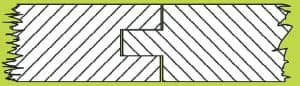
These tongue and groove parts are placed at the edges of the panel, one at the top and one at the bottom. This setup lets them lock into each other neatly, making it easy to connect one T&G board to another without any gaps.

This picture shows a cutaway view of a T&G joint, demonstrating how two panels fit together.
While wooden sheds often utilise large, single sheets of OSB (Oriented Strand Board) for their roofs and floors to keep costs down, higher-quality sheds will upgrade these areas to tongue and groove. Even if a shed features overlap wall cladding (where boards simply overlap each other like roof tiles rather than slot together), upgrading to a T&G floor and roof provides significantly better load-bearing strength and longevity.
The Difference between Tongue & Groove and Shiplap
In the garden building industry, Shiplap is actually a modified version of tongue and groove cladding. Both types use the exact same interlocking “tongue” and “groove” joint to connect the boards without visible gaps, but the difference lies in the shape of the outer face.

Standard T&G boards are flat on both sides, giving a structure a smooth, contemporary finish. Because the board maintains a uniform thickness from top to bottom, it offers highly consistent insulation and structural rigidity.
Shiplap T&G, on the other hand, features a scalloped (curved) recess along the top edge of each board. This creates a slight “lip” that overlaps the board below it. This specific design acts as a drip channel, forcing rainwater to run off the wood much faster. Because of this extended lip, even if the timber naturally shrinks during hot weather, the joint between the wood usually stays covered.
Ready to Choose Your Shed Cladding?
Now that you understand the mechanics behind the tongue and groove joint, you know exactly why it is the go-to choice for premium, weather-resistant garden buildings..

However, deciding whether to invest in the heavy-duty security of Tongue and Groove or a different option depends on your specific needs.
To see a direct comparison of price, security, and weather resistance across the different styles, head over to view our comprehensive shed cladding comparison guide..
Or, if you are already convinced that a premium interlocking build is right for you, browse our full range of Tongue and Groove Sheds today to find your perfect garden storage solution.
Shop Reverse Apex Workshop